Page 8 of 8

Entering into the Silence

by Tim Lietzke

Recently during worship Lucky offered a message in which she distinguished between “being silent” and “entering into the silence”. I have pondered the difference, and especially the meaning of the latter. Being silent seems clear enough–to stop talking, and perhaps also to stop thinking, and thus to stay attentively open to what is. Entering into the silence is another matter. First, it seems necessary to acknowledge that the one entering into the silence must have been either out of the silence beforehand or not consciously there. Being silent is the preliminary step to entering into the silence. Perhaps “the silence” is one way of expressing the Ground of all being, the creative force of the universe, the presence of God or at least the medium through which the divine presence is known. The silence is what was before all we know was, before the unfolding of the creation from the quantum dimension, beyond time and space. Taken as such, to enter into the silence is to enter the primordial, undifferentiated state of pure Being, if only briefly, leaving behind, as it were, our contingent beings. Let me not be presumptuous here; maybe this state is only that of the brain wave patterns of deep meditation or sleep.

In any case, we grope inadequately, and perhaps mistakenly, for language to describe spiritual states. I won’t try to dilate further on this, but simply recommend entering into the silence ever and again throughout our daily lives. There is so much in the world that is disconcerting, so much to throw us off center. Note how in the course of conversations and events we can easily become emotionally distraught. Entering into the silence anew re-centers us and enables the loving response to what is.

This latter assertion does need elaboration. Augustine suggests that humans are by nature good (and so too is the rest of creation) but fall into evil by virtue of our wills causing us to desire inordinately something (It can be anything.) that is less than the supreme good, that is to say, God. This turning from the supreme good to lesser goods others call idolatry, a more subtle form than the old idolatry of worship of images. Inordinate attachment robs us of our freedom and leads us into ways of living–some habitual, some sporadic, most of seemingly insignificant consequence from the individualistic point of view, others of obviously destructive consequence–that conduce to the sort of world in which we live today. If this be true, it is incumbent upon us to ponder from time to time whether our desires and attachments have become misplaced or inordinate, and thus harmful to ourselves and to the life community of planet Earth. In the silence then we may find ourselves accepted and being made whole and the freedom-robbing power of thoughts, actions, and ways of living based on inordinate desires and attachments loosened. Freedom comes in entering into the silence again and again until it becomes habitual in our daily lives and is experienced as nothing less than coming home.

*****************

Entrar en el Silencio

Escrito por Tim Lietzke

Recientemente durante el culto Lucky ofreció un mensaje en el cual distinguió entre “estar silencioso” y “entrar en el silencio”. He pensado en la diferencia, y especialmente en el significado del último. “Estar silencioso” parece bastante claro–dejar de hablar, y tal vez también dejar de pensar, y por eso quedarse atentativamente abierto a lo que esté. “Entrar en el silencio” es cosa aparte. Primero, parece necessario admitir que uno que está entrando en el silencio tenía que haber estado afuera del silencio antes o no conscientemente allá. “Estar silencioso” es la etapa preliminar para entrar en el silencio. Acaso “el silencio” es un modo de expresar la fundación de toda existencia, la fuerza creativa del universo, la presencia de Dios o al menos el medio a través de que la presencia divina está conocida. El silencio es lo que fue antes de todas las cosas que conocemos fueran, antes del despliegue de la creación desde la dimensión quantum, fuera del tiempo y espacio. Tomado así, “entrar en el silencio” es entrar en el estado primordial y indiferenciado de existencia pura, aun si sólo brevemente, dejando atrás, por así decirlo, nuestras existencias contingentes. Déjame no estar presuntuoso en este; quizá este estado es sólo eso de los patrones de las ondulaciones cerebrales de la meditación fonda o de súeño.

En todo caso, andamos a tientas inadecuadamente, y acaso equivocadamente, para las palabras que pueda describir los estados espirituales. No trataré de dilatar más sobre esto, pero simplemente recomendar que entremos en el silencio de nuevo y de nuevo durante todo el día. Hay tan mucho en el mundo que está desconcertante, tan mucho que nos lanza de nuestros centros. Note cómo en el curso de las conversaciones and acontecimientos podamos fácilmente llegar a ser turbados. Entrar en el silencio de nuevo nos recentra y capacita la respuesta amorosa a que esté.

Esta última aseveración necessita explicación. Augustino sugiere que los humanos son por naturaleza buenos (y así también es el resto de la creación) pero caen en la maldad en virtud de que nuestras voluntades nos causan a desear inmoderadamente alguno (Puede ser cualquier cosa.) que es menos que el bueno supremo, es decir, Dios. Este viraje del bueno supremo a los buenos menores otras personas llaman idolatria, una forma más sutil que la idolatria vieja del culto de imagenes. El apego inmoderado nos roba nuestra libertad y nos induce en vias de vida–algunas habituales, algunas esporádicas, la mayoría de consecuencias aparentemente insignificantes del punto de vista individual, otras de consecuencia obviamente destructiva–que conducen al tipo de mundo en el cual vivimos ahora. Si esto es verdadero, es necessario que examinemos de vez en cuando si nuestros deseos y apegos han llegado a ser otorgados indebitamente o inmoderados, y por consiguiente perjudiciales a nosotros y a la comunidad de la vida de la Tierra. En el silencio, entonces, podemos encontrarnos aceptados y estando hecho enteros mientras el libertad-robando poder de pensamientos, acciones, y vias de vida basadas en inmoderados deseos y apegos se aflojan. La libertad viene por medio de entrar en el silencio de nuevo y de nuevo hasta que llegue a ser habitual en nuestras vidas diarias y es experimentado como nada menos que venir a hogar.

Reflections on Sustaining the Quaker Tradition

by Timothy M. Waring
May 14, 2017

I wonder about the future of Quakerism. Being born into the Quaker tradition, I will forever be rooted in the way of Friends. I love un-programmed Quakerism for its shared meditation, its focus on social justice and simplicity, and for those reasons I want Quakerism to flourish. But, as a social scientist I worry about how long the Quaker tradition will survive.

As a scientist, I study the dynamics of human cooperation. Cooperation, the voluntary generosity which sustains families and builds nations, is important in nearly everything we do as humans. But, as we know from personal experience, cooperation is not guaranteed. Behavioral science has shown that cooperation flourishes where those who contribute also derive benefit, but dissolves when those who benefit never chip in. When this free-riding goes unchecked it spells disaster for the group.

I use cooperation science to study co-operatives as a type of organization. Like all organizations, co-ops face external challenges. But, co-ops are special because they generally do not rely on hierarchical structures to guarantee and manage the division of labor, and must rely on the voluntary cooperation of their members. Current research suggests that adaptations to promote cooperation within co-ops are just as important to their survival as other external influences.

Un-programmed Friends Meetings are, of course, a type of religious co-operative. Quakers share spiritual leadership of the meeting. We share the daily work of practical matters. We share responsibility for financial support of the meeting. Many co-ops use democratic decision-making to share power among members. Quakers go further with the practice of consensus, which favors unanimous decisions. I agree with Quaker practice in principle, but when I consider some of our practices in the light of recent science, they give me pause, because co-ops often fail under the burden of maintaining cooperation.

Quakers are in decline. In the United States, meetings are aging and membership is dwindling. My home meeting in Orono, Maine, is on the very verge of closing. Outside of two young families, it has about 5 regular attenders, all over the age of 70. Unfortunately, this trend is large, and is not abating, as data from the US Census and Google both show.


Better data can surely be found, but these are sufficient to show a downward trend in both the numbers of US Quakers and global interest in Quakers via web searches. This same trend influences the Monteverde Friends Meeting in Costa Rica, which we have attended this year. Although many times larger than the Orono Friends Meeting, the Monteverde Friends Meeting is growing older, and younger members are rare. So, as a Friend, I think it is time to accept that our religious co-operative may expire if we do not change something, if we do not adapt.

Many Friends have already considered how to adapt while staying true to our values. But the science of cooperation can help us gain clarity on the matter, in a few ways.

In the last few decades, behavioral scientists have learned what distinguishes cooperative groups. A handful of factors help cooperation flourish. These include, a strong shared identity, clear group membership boundaries, reciprocity among members, clear rules of participation, fair distribution of work and benefits, appropriate responses for rule-breakers, sufficient group size, and frequent interchange between groups. Many of these are areas in which Friends meetings could afford extra attention.

For example, although Friends do have a strong sense of collective identity, Quakers are also very inclusive in their spiritual beliefs. There are many Christians, Agnostics, Buddhists, Jews and Atheists among the Quakers. I celebrate that diversity, of course, but we should take care to re-affirm our collective identity as well. I know from my own research that diversity in social identity directly reduces cooperation. So, how do we build and renew our collective identity?

Take group boundaries as another example. What are the expectations of attenders in comparison to members? What are the benefits of being a member over that of an attender? In my adult life, I have participated in three meetings (Florida, Maine, California and Costa Rica). In each of these I have seen, and been surprised by, how many regular attenders were not in fact members. Moreover, in some places the major roles in the meeting were held by non-members, even the clerk.

Of course, this happens naturally, if it is easier to simply attend. If one could gain all the benefits without paying any additional costs, why become a member? Indeed, it seems that becoming a member mostly means shouldering extra responsibility for the care of the meeting. Indeed, even as a birthright Friend and frequent attender I have yet to become a member, perhaps for this reason. But Quaker adherence is evaporating. So, I encourage us to reflect on the question: why should people join meeting? What are the benefits to cooperating? Do the cooperators (members) gain especially by their role, or do they instead support a comfortable spiritual life for those who never join, never become members, and never contribute?

As another example, reciprocity is a wonderful and simple tool for maintaining cooperation. Reciprocity comes in many flavors – direct reciprocity between two people, indirect reciprocity within a group. Indirect systems of reciprocity may be one-to-one (members share rides), one-to-many (a gift to the meeting), many-to-one (a meeting supports a specific member for a special cause), or even many-to-many (such as a potluck). What is important with any system of reciprocity, though, is that it is truly reciprocal. In due course, the givers must also be the beneficiaries. Usually, reciprocity is unofficial, and this can be beautiful. When everyone truly contributes, marvelous things emerge. However, reciprocity often falls apart, leaving a few key contributors holding the weight. This can be avoided by making reciprocity just a little more official. For example, attenders could take turns being greeters or spokespeople after meeting. If turns are taken, then shirking becomes easier to observe and resolve. Are the unofficial systems of reciprocity in the meeting working, or is the work falling unevenly on a few? Can we systematize the reciprocity so that we all may know just how much we are expected to contribute, and when?

Work and reward should also be proportional. So, most meetings have a rotating volunteer clerk position. This can be successful if there are sufficient numbers of people with available time and interest. Of course, there are not always such numbers. So, we might consider whether the clerks, those who give the most to our meetings, might be compensated for their organizational and service work.

There are many ways to support cooperation, and many of them involve creating systems and institutions to make cooperation and participation easier. Clear rules and expectations are critical. But when the community is small enough, sometimes rules are never developed or information is not shared because “everyone already knows.” But without clear announcements, how can newcomers learn our expectations and rules? Will a lack of clear participation guidelines will result in fewer contributions?

As another example, I recently spoke with a young family in Monteverde who had been interested in attending the Quaker Meeting, but were unsure about whether to bring their young children. They approached several members of the Meeting, asking what the expectations were for children in Meeting, if there was a first-day school, and how it worked and were confused and disappointed when they received divergent answers. Are our expectations clear to visitors as well as ourselves?

A related issue is that of punishment for breaking the rules. Cooperation science has clearly established that if free-riding (or rule-breaking) is punished, cooperation is enhanced. But as pacifists Quakers are gentle people, and we are not inclined much toward punishment, corporal or otherwise. However, we should understand that punishment need not be punitive. Instead we can look for ways to simply shift the best choice of action to the one that benefits the group. For example, how do we use the reputation accumulated by our elders to protect the sense and decorum of the meeting? If certain members are not respectful of the communal silence that underlies Quaker spiritual practice, how can we provide an appropriate response which encourages them toward a practice sensitive to the whole meeting?

A final consideration for Quakerism at large is that of cultural transmission. To survive, organizations must transmit their values and operations to new people. But how are we Quakers doing this? Many religious employ active or even aggressive systems to proselytize and convert new members, such as the Mormons and the Jehovah’s Witnesses. Such an approach is far from Quaker belief, and adopting such a practice would, I think, damage the sacred sense of individual respect that Quakerism is founded on. But as scientists we can understand why other religions hunt converts; it helps them survive. So, we must ask if our open-door policy and voluntary contributions are working? Are our youth programs sufficiently enriching and engaging? Beyond our values, are we passing on the daily operational practice of Quakerism enough for the tradition to survive? No, we are not. Each year there are fewer Quakers and fewer Meetings.

I do not have the answers to these inquiries. Each meeting must answer to its own fate. But it is their fates that worry me. My wish is for Friends Meetings to deeply and skeptically inspect their own operations, as a detached social scientist would, for meetings to ask the hard questions, and to look for the best solutions, not the most comfortable answers. If we are faced with the existential question, then we need to ask: What do we want?

******************************

Reflecciones sobre sosteniendo la tradición Cuáquera

Escrito por Timothy M. Waring
14 de mayo, 2017

Me pregunto acerca del futuro del cuaquerismo. Habiendo sido nacido dentro de la tradición cuáquera, estaré siempre arraigado dentro de la manera de los Amigos. Amo el Cuaquerismo no programado por la meditación compartida, su enfoque sobre la justicia social y su sencillez y por estas razones quiero que prospere el cuaquerismo. Sin embargo, como científico social, me preocupa por cuánto tiempo sobrevivirá la tradición cuáquera.

Como científico, estudio las dinámicas de la cooperación humana. La cooperación, la generosidad voluntaria que sostiene las familias y edifica naciones, es importante en casi todo lo que hacemos como humanos. Pero lo sabemos por experiencia personal, la cooperación no es garantizada. La ciencia del comportamiento humano nos demuestra que existe la cooperación principalmente cuando los que contribuyen también derivan un beneficio, pero desaparece cuando los que benefician nunca aportan. Cuando el beneficio gratuito va sin límite esto sin duda implicará el desastre para el grupo.

Yo uso la ciencia cooperativa para estudiar las cooperativas como un tipo de organización. Como todas las organizaciones, las cooperativas enfrentan retos externos. Pero las cooperativas son especiales porque por lo general, no dependen de una estructura jerárquico para garantizar y manejar la división de trabajo, y deben depender de la cooperación voluntaria de sus miembros. La investigación actual sugiere que hacer adaptaciones para promover la cooperación dentro de las cooperativas es tan importante para su sobrevivencia como otras influencias externas.

Las Reuniones no programadas de los Amigos son, por supuesto, un tipo de cooperativa religiosa. Los Cuáqueros comparten el liderazgo de la reunión. Compartimos el trabajo diario de asuntos prácticos. Compartimos la responsabilidad de apoyo financiero de la reunión. Muchas cooperativas toman sus decisiones democráticamente para compartir el poder entre sus miembros. Los Cuáqueros van aún más allá, usando la práctica del consenso, que favorece decisiones tomadas con el sentido de unanimidad. Estoy de acuerdo con los Cuáqueros en principio, pero cuando considero algunas de nuestras prácticas a la luz de la ciencia reciente, me hace dudar, debido a que las cooperativas frecuentemente fallan bajo el peso de mantener la cooperación.

Los Cuáqueros están en declive. Las Reuniones en los Estados Unidos, están envejeciendo y existe una constante reducción en la membresía. La Reunión donde soy miembro en Oronto, Main, está al borde de cerrar. Fuera de dos familias jóvenes, tiene apenas unos 5 asistentes regulares, todos mayores de 70 años. Desgraciadamente esta tendencia es extendida y no variando, como muestra información tanto del censo estadounidense como Google.

Seguramente se puede mejor el data, pero estas dos fuentes son suficientes para mostrar la tendencia hacia abajo tanto en el número de Cuáqueros estadounidenses como el interés sobre los Cuáqueros a través de búsquedas en el web. Esta misma tendencia está influenciando la Reunión de Amigos de Monteverde en Costa Rica, donde asistimos este año. Aunque muchas veces más grande que la reunión de Amigos de Oronto, la Reunión de los Amigos de Monteverde se está haciendo más vieja y los miembros jóvenes son pocos. Así como un Amigo, creo que es tiempo de aceptar que nuestra cooperativa religiosa puede morir si no cambiamos algo, si no nos adaptamos.

Muchos Amigos ya han considerado como adaptarse mientras se mantienen nuestros valores. Sin embargo la ciencia de la cooperación nos puede obtener claridad sobre el tema, en algunas maneras.

En las últimas décadas, científicos del comportamiento humano, han aprendido distinguir diferentes grupos cooperativos. con unos cuantos factores podrá ayudar prosperar la cooperación. Estos incluyen, una fuerte identidad compartida, claros límites para la membresía grupal, reciprocidad entre miembros, reglas claras de participación, una distribución justa de trabajo y beneficios, respuestas apropiadas para los que infringen las reglas, un tamaño de grupo suficientemente grande, y frecuente intercambio entre grupos. Muchos de estos son áreas en que las reuniones de los Amigos podrán dedicar extra atención.

Por ejemplo, aunque los Amigos tienen un fuerte sentido de identidad colectiva, los Cuáqueros son también muy inclusivas en sus creencias espirituales. Hay muchos Cristianos, Agnósticos, Budistas, Judíos y Ateos entre los Cuáqueros. Yo celebro esta diversidad, desde luego, pero debemos tener cuidado de reafirmar nuestra identidad colectiva también. Sé de mi investigación personal que la diversidad en la identidad social reduce directamente la cooperación. Así que, cómo podríamos construir y renovar nuestra identidad colectiva?

Tomen los límites grupales como otro ejemplo. Qué son las expectaciones de los que atienden en comparación a los miembros? Cuáles son los beneficios de ser miembro sobre el que asiste? Durante mi vida de adulto, he sido participante en 3 Reuniones (Florida, Maine, California y Costa Rica). En cada una de ellas he visto y he sido sorprendido, la cantidad de asistentes regulares que de hecho, no eran miembros. Lo que es más, muchos de los que ocupaban mayores roles en las Reuniones no eran miembros, hasta la persona que dirigía las reuniones de negocios.

Desde luego esto pasa naturalmente, si es más fácil para simplemente asistir. Si se puede ganar todos los beneficios sin pagar los costos adicionales, para que ser miembro? En verdad, pareciera que ser miembro implica cargar más responsabilidades para el cuidado de la reunión. Lo cierto, aún siendo un miembro de los Amigos por nacimiento y asistente frecuente aún no soy miembro de una Reunión, tal vez por esta misma razón. Pero la adhesión para ser Cuáquero está evaporando. Así que, les insto refleccionar sobre esta pregunta: Por qué se debería unir a una Reunión? Cuáles son los beneficios para cooperar? Ganan quienes son miembros cooperadores por su rol, o de otra manera, sostienen la confortable vida espiritual de los que nunca se unen, nunca son miembros y nunca contribuyan?

Como otro ejemplo,la reciprocidad es una herramienta hermosa y sencilla para mantener la cooperación. La reciprocidad viene en muchos sabores – reciprocidad directa entre dos personas, reciprocidad indirecta es dentro de un grupo. Sistemas indirectas de reciprocidad puede ser de uno a otro (los miembros comparten viajes), uno a varios (un regalo a la Reunión), muchos a uno ( la Reunión da su apoyo a un miembro específico por una causa específica), o aún muchos a muchos (como un almuerzo compartido). Lo que es importante con cualquier sistema de reciprocidad, es que sea verdaderamente recíproco. En el curso debido, los que dan deben ser los beneficiarios. Normalmente la reciprocidad es no-oficial y esto puede ser algo bello. Cuando todos verdaderamente contribuyen, emergen cosas maravillosas. Sin embargo, frecuentemente la reciprocidad se desmorona, dejando unos pocos contribuyentes sosteniendo todo el peso. Esto se puede evitar haciendo que la reciprocidad sea un poco más oficial. Por ejemplo, los que asisten deben tomar turnos para ser los que dan la bienvenida después de la Reunión. Si se turnan, el que no cuple es más fácilmente detectado y resuelto. Están funcionando los sistemas de reciprocidad no oficial en la reunión, o está recayendo el peso desmedidamente en unos pocos? Podemos sistematizar la reciprocidad de manera que todos podamos saber cuánto se espera de contribución y cuándo?

El trabajo y recompensa también debe ser proporcional. Así que la mayoría de las Reuniones tienen la posición de conductor de las sesiones como puesto voluntario y rotativo. Esto puede tener éxito donde hay suficientes miembros con personas con tiempo disponible e interés. Por supuesto no siempre hay esta cantidad de personas. Así que podríamos tomar en consideración si ellos, quienes dan más a la Reunión, podrían ser compensados por su trabajo de organización y servicio.

Hay muchas maneras de apoyar la cooperación, muchas involucran crear sistemas e instituciones para hacer que la cooperación y participación sea más fácil. Tener reglas claras y expectaciones son esenciales. Pero cuando es suficiente pequeña la comunidad, a veces las reglas nunca son desarrolladas o la información compartida porque – Todo el mundo sabe -. Pero sin comunicaciones claras, cómo pueden los que son recién llegados aprender cuales son las expectativas y reglas? Creen que habrán menos contribuciones por falta de reglas de participación claras?

Como otro ejemplo, hablé recientemente con una familia joven en Monteverde quienes habían estado interesados en atender la Reunión de los Cuáqueros, pero no estaban seguros si traer sus niños pequeños. Habían acercado a varios miembros de la Reunión a preguntarles que eran las expectativas acerca de traerlos a la Reunión y si había una escuela de Primer Día y cómo funcionaba. Fueron confundidos y decilucionados cuando recibieron contestaciones divergentes. Son nuestras expectaciones claras a nuestros visitantes como a nosotros mísmos?

Un tema relacionado es el castigo por el rompimiento de las reglas. La ciencia de la cooperación ha establecido claramente que si el que anda libre (rompe reglas) es punible, se mejora la cooperación. Pero como pacifistas, los Cuáqueros son personas suaves, y no somos muy inclinados al castigo, corporal o de otra manera. Sin embargo, debemos entender que el castigo no necesariamente debe ser punitivo. En cambio, podemos buscar maneras de simplemente cambiamos el mejor curso de acción a uno de los beneficios del grupo. Por ejemplo, cómo usamos la reputación acumulado por nuestros ancianos para proteger el sentido y decoro de la Reunión? Si ciertos miembros no son respetuosos del silencio comunal que es base de la práctica espiritual Cuáquera, cómo podemos proporcionarle con una respuesta adecuada que le estimula hacia una práctica que sea sensible a toda la reunión?

Una consideración final para el Cuaquerismo en general es la transmisión cultural. Para sobrevivir, las organizaciones deben comunicar sus valores y operaciones a la gente nueva. Pero cómo nosotros los Cuáqueros la estamos haciendo? Muchas religiones aplican sistemas activas y hasta agresivas para predicar y convertir a nuevos miembros, como por ejemplo los Mormones y Testigos de Jehová. Tal manera de llegar está lejos de la creencia Cuáquera, y adoptar tal práctica dañaría, pienso yo, el sentido sagrado del respeto del individuo sobre el cual está basado el Cuaquerismo. Pero como científicos podemos entender el porqué otras religiones cazan a los que quieren convertir ya que les ayudan a sobrevivir. Así que debemos preguntar si nuestra política de puertas abiertas y contribuciones están funcionando? Si nuestros programas para nuestra juventud son suficientemente enriquecedoras y atractivas? Más allá de nuestros valores, estamos pasando suficientes prácticas diarias operacionales Cuáqueras para que puede sobrevivir sus tradiciones? No. no lo estamos haciendo. Cada año hay menos Cuáqueros y reuniones.

No tengo las respuestas a estos interrogantes. Cada Reunión debe responder a su propio destino. Pero son sus destinos que me preocupa. Mi deseo es que las Reuniones de los Amigos inspeccionen con profundidad y escepticismo sus propias operaciones, como lo haría un científico social desligado de emociones, para que las Reuniones se hagan las preguntas difíciles, y buscar por las mejores soluciones, no las respuestas más cómodas. Si estamos encarados con la pregunta existencial, entonces deberíamos preguntar: Qué queremos?
Monteverde Monthly Meeting Draft Statement on Migration

12 June, 2017

The Religious Society of Friends (Quakers) transcends national boundries. Our primary alligience is to God as the Spirit of Love moves in our lives. Here in Monteverde, Costa Rica, our meeting’s membership includes citizens of Costa Rica, USA, and Canada. The life of our meeting is enriched by attenders from many parts of the world.

The world is currently facing a global crisis of migration: massive uprooting of peoples due to war, environmental disasters, and extreme poverty. During the past two years Costa Rica has experienced a part of this migration as large numbers of Cubans, Haitians, and people from parts of Africa and the Middle East have been concentrated in the isthmus in a mass migration from South America to North America. While small on a global scale, it has been significant for a country as small as Costa Rica. The Costa Rican government has responded in a humanitarian way, providing safe conduct, health care, and basic temporary food and shelter. The Monteverde Meeting has joined with others in Costa Rica in raising donations for the displaced families and visiting the camps to bring a bit of joy and comfort.

Meanwhile, we are appalled to see the cruel immigration policies enacted by the current administration in the United States. Families are being ripped apart. People who have lived peacefully in the USA for many years are being treated like criminals and torn from the life they have made for themselves and deported to countries where they have not been in many years. We are especially concerned about people who have fled life-threatening conditions in Northern Triangle countries (Guatemala, El Salvador, and Honduras) where drug gangs and substantially failed-state conditions threaten the lives of young people who refuse to participate in violent gangs and the safety of family and friends of youth who refuse gang coercion.

Monteverde Monthly Meeting of Friends wishes to express our solidarity with people who have had to leave their country of origin and are persecuted for doing so. We reach out to Friends and others who are guided by a Spirit of Love to make it possible for people to live and work in peace. We understand that this international situation requires an international response. We wish to work with people in other nations to find practical solutions. Within our limitations as a small meeting we are open to receiving and assisting Spanish speaking people who would otherwise be deported to dangerous regions. We also desire to work with Friends in the northern triangle to find ways to nurture peace and stability in Central America. We would like to hear from others to explore creative practical ideas.

**************

Reunión mensual de Monteverde
12 de junio de 2017
Borrador de declaración

La Sociedad Religiosa de Amigos (Cuáqueros) trasciende los límites nacionales. Nuestro principal alligience es Dios como el espíritu de amor mueve en nuestras vidas. Aquí en Monteverde, Costa Rica, la membresía incluye a ciudadanos de Costa Rica, Estados Unidos y Canadá. La vida de nuestra comunidad se enriquece con asistentes de todas partes del mundo.

El mundo enfrenta actualmente una crisis global de la migración: desarraigo masivo de poblaciones debido a la guerra, desastres ambientales y la pobreza extrema. Durante los últimos dos años que Costa Rica ha experimentado una parte de esta migración masiva de cubanos, haitianos y personas de partes de África y Oriente Medio se han concentrado en el istmo en una migración masiva de América del sur a América del norte. Aunque pequeño a escala mundial, ha sido significativa para un país tan pequeño como Costa Rica. El gobierno costarricense ha respondido de una manera humanitaria, proporcionando salvoconducto, cuidado de la salud y necesidades básicas de alimentos y refugio. La reunión de Monteverde se ha unido con otros en Costa Rica en el envio de donaciones para las familias desplazadas y visitas a los campamentos para brindar un poco de alegría y comodidad.

Mientras tanto, estamos horrorizados al ver las políticas de inmigración cruel promulgadas por la actual administración en los Estados Unidos. Las familias están siendo desgarradas. Personas que han vivido pacíficamente en Estados Unidos durante muchos años son tratados como criminales y arrancada de la vida que han hecho para sí mismos y deportados a países donde no han vivido en muchos años. Nos preocupa especialmente sobre personas que han huido de condiciones peligrosas en los países del Triángulo Norte (Guatemala, El Salvador y Honduras) donde narcotraficantes y politicas desastres amenazan las vidas de los jóvenes que se niegan a participar en pandillas violentas y la seguridad de la familia y amigos de juventud que niegan la coerción de la cuadrilla.

La Reunión Mensual de amigos de Monteverde desea expresar nuestra solidaridad con las personas que han tenido que abandonar su país de origen y son perseguidas por ello. Buscamos enlaces con Amigos y otros que son guiados por un espíritu de amor para que sea posible para las personas a vivir y trabajar en paz. Entendemos que esta situación internacional requiere una respuesta internacional. Queremos trabajar con personas en otras naciones a encontrar soluciones prácticas. Dentro de nuestras limitaciones como una pequeña reunión estamos abiertos a recibir y ayudar a personas de habla hispana que de lo contrario serían deportadas a regiones peligrosas. También queremos trabajar con Amigos en el Triángulo Norte a encontrar maneras de fomentar la paz y la estabilidad en América Central. Nos gustaría escuchar de otras personas para explorar ideas prácticas creativas.

Time to Get Moving

by Katy VanDusen

When I arrived on the bus to Monteverde in 1980, Marvin Rockwell picked me up in a golf cart. At that time, there were only about five cars in the whole zone (not including the golf cart). People moved from one place to another on foot, horse, moto, and on milk trucks. On the way, we socialized with our neighbors, stopping to talk with people on the road, hugged the person driving the moto, and having long conversations on the bus.

Since then, the number of cars in the country has grown over 900% from about 82,000 to about 800,000 (according to Amelia Rueda). The Central Valley traffic jams the streets, downtown Santa Elena experiences gridlock, and our Meeting parking lot often overflows. And we zoom by our neighbors rather than connecting with them.

Costa Rica aims to be carbon neutral, but because of the growing number of vehicles, especially cars, greenhouse gas emissions continue to increase. Automobiles are the main source of emissions in Costa Rica and in our Meeting-School Community. The Meeting Carbon Neutrality committee found that more than 90% of our emissions at the school come from transportation to the meeting and school. That does not include our air travel.

So, what can we do?

Many ideas were shared at the event “Monteverde towards Modern and Ecological Transport” on 25 May. Here are some of the actions that were mentioned by the different presenters, from higher to lower impact:

· Switch to an electric vehicle. Since over 95% of Costa Rica’s energy comes from renewable energy, driving an electrical vehicle here can cut emissions by about 95%. Four meeting families are already using small electric vehicles locally. (See below for more information on electric vehicles.)

· Write to the diputados who represent Puntarenas to ask them to exonerate the taxes on electric vehicles: laura.garro@asamblea.go.cr, karla.prenda@asamblea.go.cr, olivier.jimenez@asamblea.go.cr, gerardo.vargas.rojas@asamblea.go.cr, and carlos.hernandez@asamblea.go.cr. Very few electric automobiles are available in Costa Rica because the government is still taxing them at the same rate as other vehicles.

· Walk, just like Monteverdeans used to, and many still do! You benefit from the exercise and the atmosphere does, too!

· Ride a bike (regular or electric).

· Use collective transportation. According to the Union of Concerned Scientists, bus travel emits about one sixth of the amount of CO2 per person that a regular SUV with three passengers does.

· Share rides. Give rides. Ask for rides. Carpool. Share taxis. When one car travels instead of two, emissions are cut in half.

· Drive efficiently. Accelerate and decelerate slowly. Turn off your car while waiting. Don’t fill your tank in the heat of the day to minimize the amount of CO2 that vaporizes. Don’t top-off your tank. When driving, try to stay between 1500 and 2000 rpm for diesel vehicles and 2000 and 2500 rpm for gasoline vehicles. You can save up to 30% in fuel by driving efficiently.

· Maintain your car well. Note: when your car passes RITEVI, that does not mean that your car is not emitting carbon dioxide or other greenhouse gases. It means that it is not emitting more than the maximum amount permitted by law.

· Compensate your carbon footprint by donating to the soon-to-be-established Carbon Offset Fund at the Monteverde Community Fund.

Another idea that was presented on 25 May was the need to understand the transportation needs in the zone in order to improve public transportation. Since then, CORCLIMA (the Monteverde Commission for Resilience to Climate Change) with support from the Concejo de Distrito Municipal, has submitted a grant proposal to obtain funds doing a participatory study as the first step in providing convenient, affordable, low-emission transportation for everyone.

Here is more info about electric vehicles:

· You can recognize an electric car because it is quieter than a vehicle with an internal combustion engine and it plugs in.

· 85% of electric cars in the world are charged at home.

· Costa Rica has already installed 9 rapid charging stations and about 110 more are planned.

· Venus Motors is planning on opening a factory in Guanacaste that will convert conventional vehicles to electric.

· Batteries are improving fast and getting cheaper. So is the range of electric vehicles, up to 500 km per charge.

· The Mitsubishi Outlander PHEV is a 4-wheel drive electric plug-in hybrid that is now available in Costa Rica. As a hybrid, its range is not limited.

Please put two events on your calendar:

· 30 July at the rise of meeting we will have a 90-minute meeting about what we can do individually and collectively to lower our emissions. No doubt you have many great ideas not mentioned here.

· 30 September Monica Araya of Costa Rica Limpia is coming to Monteverde to talk about collective and electric transportation. Check out her TED talk proposing that Costa Rica abolish fossil fuels just as it abolished its army.

Hope to see you there!
– Katy

*****************

Hay que movilizarnos

Escrito por Katy VanDusen

Cuando llegué en el bus a Monteverde en 1980, Marvin Rockwell me recogió en un carrito de golf. En ese momento, había sólo cinco carros en toda la zona (sin incluir el carrito de golf). La gente se movía de un lugar a otro a pie, a caballo, a moto, y en camiones de leche. En el camino, nos socializamos con nuestros vecinos, parando para hablar con la gente en el camino, abrazando a la persona que conducía la moto, y teniendo largas conversaciones en el bus.

Desde entonces, el número de automóviles en el país ha crecido más de 900%, de alrededor de 82.000 a alrededor de 800.000 (según Amelia Rueda). El tráfico del Valle Central atasca las calles, el centro de Santa Elena experimenta bloqueos, y nuestro parqueo a menudo desborda. Y pasamos nuestros vecinos rápidamente en vez de conectarnos con ellos.

Costa Rica pretende ser carbono neutro, pero debido al creciente número de vehículos, especialmente de automóviles, las emisiones de gases de efecto invernadero continúan aumentando. Los automóviles son la principal fuente de emisiones en Costa Rica y en nuestra escuela y mitin. Nuestro Comité de Carbono Neutralidad del mitin y escuela encontró que más del 90% de nuestras emisiones vienen de transporte al culto y la escuela. Eso no incluye nuestros viajes aéreos.

¿Entonces, qué podemos hacer?

Muchas ideas fueron compartidas en el evento Monteverde hacia el Transporte Moderno y Ecológico el 25 de mayo. Aquí están algunas de las acciones que fueron mencionadas por los diferentes presentadores, de mayor a menor impacto:

• Cambie a un vehículo eléctrico. Dado que más del 95% de la energía en Costa Rica proviene de energía renovable, conducir un vehículo eléctrico aquí puede reducir las emisiones en un 95%. Cuatro familias de reunión ya están usando pequeños vehículos eléctricos localmente. (Vea abajo para más información sobre vehículos eléctricos.)

• Escribir a los diputados que nos representan para pedirles que exoneren los impuestos sobre vehículos eléctricos: laura.garro@asamblea.go.cr, karla.prenda@asamblea.go.cr, olivier.jimenez@asamblea.go.cr, gerardo.vargas.rojas@asamblea.go.cr, y carlos.hernandez@asamblea.go.cr. Muy pocos automóviles eléctricos están disponibles en Costa Rica porque el gobierno todavía está imponiendo los mismos impuestos que otros vehículos.

• Caminar, al igual que Monteverdeños hicieron en el pasado, y muchos todavía hacen! ¡Usted se beneficia del ejercicio y la atmósfera beneficia también!

• Montar a bicicleta (regular o eléctrica).

• Usar transporte colectivo. Según la Union of Concerned Scientists, un viaje en autobús emite aproximadamente una sexta parte de la cantidad de CO2 por persona que un SUV regular con tres pasajeros.

• Compartir ride. Dar ride. Pide ride. Carpool. Compartir taxis. Cuando un carro viaja en lugar de dos, las emisiones se cortan por la mitad.

• Conduzca eficientemente. Acelerar y desacelerar lentamente. Apague su automóvil mientras espera. No llene su tanque en el calor del día para minimizar la cantidad de CO2 que se vaporiza. No sobre-llene su tanque. Al conducir, trate de permanecer entre 1500 y 2000 rpm para los vehículos de diesel y 2000 y 2500 rpm para los vehículos de gasolina. Puede ahorrar hasta un 30% en combustible conduciendo de manera eficiente.

• Mantenga bien su automóvil. Nota: cuando su carro pasa RITEVI, eso no significa que su carro no está emitiendo dióxido de carbono u otros gases de efecto invernadero. Significa que no está emitiendo más de la cantidad máxima permitida por la ley.

• Compensar su huella de carbono donando al “Fondo Compenso mi Huella” que pronto se establecerá en el Fondo Comunitario Monteverde.

Otra idea que se presentó el 25 de mayo fue la necesidad de entender las necesidades de transporte en la zona para mejorar el transporte público. Desde entonces, CORCLIMA, con el apoyo del Concejo de Distrito Municipal, ha presentado una propuesta de subvención para obtener fondos, realizando un estudio participativo como primer paso para proporcionar un transporte conveniente, asequible y con bajas emisiones para todo el mundo.

Aquí hay más información sobre vehículos eléctricos:
• Puede reconocer un carro eléctrico porque es más silencioso que un vehículo con motor de combustión interna y se enchufla.

• El 85% de los carros eléctricos en el mundo se cargan en casa.

• Costa Rica ya ha instalado 9 estaciones de recarga rápidas y cerca de 110 más están planificadas.

• Venus Motors planea abrir una fábrica en Guanacaste que convertirá los vehículos convencionales en eléctricos.

• Las baterías mejoran rápidamente y se hacen más baratas. También está mejorando la distancia que puede correr los vehículos eléctricos, hasta 500 km por carga.

• El Mitsubishi Outlander PHEV es un híbrido eléctrico enchufable de doble tracción que ahora está disponible en Costa Rica. Como híbrido, su rango no está limitado.

Por favor, coloque dos eventos en su calendario:

• 30 de julio, después del culto, tendremos una reunión de 90 minutos sobre lo que podemos hacer individualmente y colectivamente para reducir nuestras emisiones. Sin duda tienes muchas grandes ideas que no se mencionan aquí.

• 30 de septiembre Mónica Araya de Costa Rica Limpia viene a Monteverde para hablar de transporte colectivo y eléctrico.

¡Nos vemos allá!

The Future of Solar Panels in Monteverde: Net Metering

by Paul Smith

There are many reasons why in Monteverde we needs to get on board with solar panels if we really believe in sustainable and healthy community for the future. The critical issue is being lucky enough to get the service of a knowledgeable responsible provider to cover long term servicing. Any time spent checking their reputation with previous customers would be wise.

We got a good start with solar in Monteverde about two years ago when Sarah Stuckey, Joe and Jean Stuckey, Alan Master, myself, and the Monteverde Friends School installed panels. Everything worked perfectly. No more electric bill beyond the minimum of 2500 colones a month. We were happy. Then ICE closed the program and took a year to come out with a new set of regulations about hooking solar systems into the grid, thus avoiding the need for batteries. Now there are four additional families trying to install ICE-connected solar systems, but there seems to be a problem with the previous provider so I have turned to other providers. In any case, we believe that “solar (together with wind) is the way to renewable energy”.

When I heard about an organization called ACESOLAR (Associación Costaricense Energía Solar) having an exposition at the National Stadium in May, I decided to attend to discover what is happening in this country. I was delighted to discover 35 companies, some with 10 years of experience working in several countries, actively engaged in the business of putting solar panels on homes and businesses. Here are a few interesting things I found out:

1) Are the new ICE regulations fair?
Yes, they are fair. On average one must contribute a quarter of the electricity one produces to ICE for their services.

2) Who obtains the permits from ICE?
All providers explained that this was their responsibility. Each area of the country has a quota of solar panels permitted, and there are a few areas where this quota has been filled. Obtaining permits in some areas is more difficult, which means that providers must apply a little pressure. But as long as the quota has not been filled in one’s area, and ours has not, the possibility of obtaining a grid-connected solar system remains.

3) What about financing?
Providers offered a glowing report about cooperation with banks. The provider makes the arrangements, with interest as low as 2%. Details need to be checked out.

4) What is the advantage of using panels connected to the grid versus using batteries and being off the grid?
Generally being connected to the grid is cheaper and entails fewer problems. The solar provider will tell you the best options.

5) What is involved in closing a deal with a provider?
First check out their web site. Then provide them with a monthly electric bill so they have an idea of your energy use. Arrange an appointment for the provider to come and make a study of your home or business and your electric needs. They will explain what they can do and give you an estimate. They have a greater interest in coming more quickly if they have several customers to see at one time. I know of several potential customers in our area, including Pedro Belmar, Tim Curtis, and the Trostles.

I have organized a meeting at the Belmar for the public to come and listen to and talk with Alexander Alvarado Chavarria of Greenenergy (see below) at 10:00 am on Thursday, July 6. He asks potential customers to bring a copy of the list of electric consumption for the last 12 months (at least 6) and a copy of the last paid receipt of electric services. There may be future meetings with other providers as well. If you are interested in the possibility of having solar panels on your home or business and would like to attend a future public meeting with a provider or cooperate with other potential customers in arranging for provider visits, please contact me at paulwarrensmith@gmail.com.

Here are four providers I picked as a start:
> Cielovivo – Hoge Hernandez G.
Tel. 2273 6873 and 87240340.
Email. Venta@cielovivo.co.cr
Website. www.cielovivo.co.cr

> HiPower – Federico Varela Urbizo
Tel. 4000 4990 and 8712 5895
Email. solar@hipowercr.com.
Website. www.hipowercr.com
Facebook. HIPowerCR

> Costa Rica Solar Solutions – Jose Garcia Barrera
Tel. 6077 5337 or 4030 2023
Email. jose@crsolarsolutions.com.
Website. www.crsolarsolutions.com

> Greenenergy – Alexander Alvarado Chavarria
Tel. 7206 8074 or 22906405 or 2290 7727
Email. aalvarado@greenenergycr.com
Website. www.greenenery.cr

********

El futuro de los Paneles Solares en Monteverde: Medición Neta

escrito por Paul Smith

Hay muchas razones por las que en Monteverde necesitamos hacer algo en serio con los paneles solares si realmente creemos en la comunidad sostenible y saludable para el futuro. La cuestión crítica es tener la suerte de obtener el servicio de un proveedor expert y responsable para cubrir el mantenimiento a largo plazo. Cualquier esfuerzo de comprobar su reputación con clientes anteriores valdria la pena.

Tuvimos un buen comienzo con la energía solar en Monteverde hace aproximadamente dos años cuando Sarah Stuckey, Joe y Jean Stuckey, Alan Masters, yo mismo y la Escuela de Amigos de Monteverde instalamos paneles. Todo funcionó perfectamente. Ya no más factura eléctrica más allá del mínimo de 2500 colones al mes. Éramos felices. Entonces el ICE cerró el programa y tomó un año para salir con un nuevo conjunto de reglamentos sobre la incorporación de los sistemas solares en la red, evitando así la necesidad de baterías. Ahora hay cuatro familias adicionales tratando de instalar sistemas solares conectados al ICE, pero parece haber un problema con el proveedor anterior, así que me he dirigido a otros proveedores. De toda forma, creemos que “la energía solar (junto con el viento) es el camino hacia la energía renovable”.

Cuando me enteré que una organización llamada ACESOLAR, www.acesolar.org (Asociación Costarricense de la Energía Solar), estaba realizando una exposición en el Estadio Nacional en mayo, decidí asistir para darme cuenta qué está sucediendo en este país. Estuve encantado de descubrir 35 empresas, algunas con 10 años de experiencia, trabajando en varios países, activamente dedicadas al negocio de colocar paneles solares en casas y negocios. Aquí hay algunas cosas interesantes que descubrí:

1) ¿Son justas los nuevos reglamentos del ICE?
Sí, son justos. En promedio se debe aportar una cuarta parte de la electricidad que se produce al ICE por sus servicios.

2) ¿Quién obtiene los permisos del ICE?
Todos los proveedores explicaron que esto es su responsabilidad. Cada zona del país tiene una cuota de paneles solares permitidos, y en algunas áreas se ha cubierto esta cuota. La obtención de permisos en algunas áreas es más difícil, lo que significa que los proveedores deben aplicar un poco de presión. Pero mientras la cuota no haya sido saturada en su área, y la nuestra no, existe la posibilidad de obtener un sistema solar conectado a la red.

3) ¿Y la finanziamiento?
Los proveedores ofrecieron un informe alentador sobre la cooperación con los bancos. El proveedor hace los arreglos, con un interés tan bajo como 2%. Hay que averiguar los detalles.

4) ¿Cuál es la ventaja de usar paneles conectados a la red sobre el uso de baterías independientes de la red?
En general, conectarse a la red es más barato y conlleva menos problemas. El proveedor de energía solar le informará sobre las mejores opciones.

5) ¿Cuál es el proceso de cerrar un trato con un proveedor?
Primero se revisa su página electrónica. Luego, les proporciona un recibo mensual de electricidad para que tengan una idea de su uso de energía. Se obtiene una cita para que el proveedor venga y haga un estudio de su hogar o negocio y sus necesidades eléctricas. Explicarán lo que pueden hacer y le darán una estimación del costo. Tendrán más interés en llegar pronto si hay varios clientes con quien reunirse a la vez. Conozco a varios clientes potenciales en nuestra área, incluyendo a Pedro Belmar, Tim Curtis y los Trostle.

He organizado una reunión en el Hotel Belmar para que el público venga a escuchar y hablar con Alexander Alvarado Chavarria de Greenenergy (ver abajo) a las 10:00 am el jueves 6 de julio. El pide a los clientes potenciales que traigan una copia de la lista del consumo eléctrico de los últimos 12 meses (al menos 6) y una copia del último recibo pagado de los servicios eléctricos. También puede haber reuniones futuras con otros proveedores. Si le interesa la posibilidad de tener paneles solares en su casa o negocio y le gustaría asistir a una reunión pública en el futuro con un proveedo, o cooperar con otros clientes potenciales enc oordinar visitas de proveedores, póngase en contacto conmigo en paulwarrensmith@gmail.com.

Aquí hay cuatro proveedores que escogí como un comienzo:

> Cielovivo – Hoge Hernandez G.
Tel. 2273 6873 and 87240340.
Email. Venta@cielovivo.co.cr
Website. www.cielovivo.co.cr

> HiPower – Federico Varela Urbizo
Tel. 4000 4990 and 8712 5895
Email. solar@hipowercr.com.
Website. www.hipowercr.com
Facebook. HIPowerCR

> Costa Rica Solar Solutions – Jose Garcia Barrera
Tel. 6077 5337 or 4030 2023
Email. jose@crsolarsolutions.com.
Website. www.crsolarsolutions.com

> Greenenergy – Alexander Alvarado Chavarria
Tel. 7206 8074 or 22906405 or 2290 7727
Email. aalvarado@greenenergycr.com
Website. www.greenenery.cr

The I – Thou Relationship

by Tim Lietzke

Much of the world’s response to the global refugee crisis reflects the tendency to treat others as objects, what Martin Buber called an “I-It” relationship as distinguished from an “I-Thou” relationship. This applies not only to human relationships, but also to relationships with other life forms as well as with inanimate objects and experiences. Perhaps an example will clarify the distinction. When listening to a beautiful piece of music, as long as the music flows through and over one and one stays with the music, one is in an “I-Thou” relationship with the music. But as soon as one takes a mental step back, for example, to critique or analyze the music or the playing, one has fallen into an “I-It” relationship. This is not to say that “I-It” relationships are wrong or necessarily inferior.. Sometimes they are needed. However, we might ask ourselves if too often even relationships with friends and family have devolved into “I-It” relational exchanges. How often do we really meet one another heart to heart?

Let me suggest a possible daily spiritual exercise somewhat different from holding another in the Light to foster and deepen “I-Thou” relational experiences. Choose someone special in your life. Meditate on that person, their feelings and ideas, their life experiences and stories. Let the fullness of that person dwell in your heart more and more day by day. After some time you may find your relationship expressing itself increasingly in the “I-Thou” mode. Love will grow and where love grows, the world changes for the better.

********

La Relación de “Yo-Tu”

escrito por Tim Lietzke

La respuesta de muchos del mundo ante la crisis global de los refugiados refleja la tendencia de tratar a otros como objetos, que Martin Buber llamó una relación de “Yo-Eso” como distinguida de una relación de “Yo-Tu”. Esto aplica no sólo a relaciones humanas, también a las relaciones con otras formas de vida, con objetos inanimados y con experiencias.Tal vez un ejemplo puede clarificar la distinción. Cuando uno escuche una bella obra musical, mientras la música fluya a través de y sobre si mismo y se quede con la música, uno está en una relación de “Yo-Tu” con la música. Pero tan pronto como tome un paso mental atrás, por ejemplo, para criticar o analizar la música o la ejecución, uno ha caído en una relación de “Yo-Eso”. Este no es decir que las relaciones de “Yo-Eso” son malas o necesariamente inferiores. A veces son necesarias. Sin embargo, podemos preguntar a nosotros mismos si con demasiada frecuencia aún las relaciones con amigos y familia han llegado a ser intercambios de “Yo-Eso”. ¿Cada cuánto nos encontramos realmente corazón a corazón?

Déjeme sugerir un ejercicio espiritual para promover y profundizar experiencias de “Yo-Tu”. Mi sugerencia es algo diferente de tener a alguien en la Luz. Escoja a alguien especial en su vida. Medite en esa persona, su sentimientos e ideas, su experiencias de vida e historia. Deje que la plenitud de esa persona permanece en su corazón más y más día tras día. Después de algun tiempo puede descubrir que su relación se expresa cada vez más en el modo de “Yo-Tu”. El amor crecerá y donde el amor crece, el mundo mejora.

Actions You Can Take After the Womens March

by Harriet Joslin

After the Women’s march some of us met for a huddle. It was really nice to be with like-minded and committed people. One of the things we decided to do was to check out various sources of information about what is happening in US politics and how we can respond. The idea was to hone them down to send out to our Monteverde friends.

We have checked out a number of organizations which we think are doing a great job. Each of them has a slightly different slant and you can choose which ones you think will provide information most pertinent to your interests. Some of them give very specific information about what is happening and exactly what you can do to respond so they make it really easy to participate. They even help you identify your representatives and senators and how to phone or write to them. If you have Skype (or some other computer based telephone service) you can call for just a few cents.

MoveOn.org
Indivisible
FCNL (Friends Committee on National Legislation)
350.org
ACLU
DailyAction.org (texts only, but you can follow them on Facebook)

For more information you can call (2645 7043) or email (harrietjoslin@hotmail.com).

Peace, Harriet

Seguimiento de la marcha de la mujer

escrito por Harriet Joslin

Después de la marcha de la Mujer algunos de nosotros nos reunimos para un “huddle.” Fue muy agradable estar con gente de ideas afines y comprometida. Una de las cosas que decidimos hacer fue ver varias fuentes de información sobre lo que está sucediendo en la política de Estados Unidos y cómo podemos responder. La idea era ayudarlos a enviar a nuestros amigos de Monteverde.

Hemos revisado varias organizaciones que creemos están haciendo un gran trabajo. Cada uno de ellos tiene una inclinación ligeramente diferente y usted puede elegir cuáles cree que proporcionará la información más pertinente a sus intereses. Algunos de ellos dan información muy específica sobre lo que está sucediendo y exactamente lo que puede hacer para responder, por lo que hacen muy fácil participar. Incluso le ayudan a identificar a sus representantes y senadores y cómo telefonear o escribir a ellos. Si tiene Skype (o algún otro servicio telefónico basado en computadora) puede llamar por sólo unos pocos centavos.

MoveOn.org
Indivisible
FCNL (Friends Committee on National Legislation)
350.org
ACLU
DailyAction.org (texts only, but you can follow them on Facebook)

Para más información puede llamar al (2645 7043) o por correo electrónico (harrietjoslin@hotmail.com).

Paz, Harriet

Solidarity with Migrants in Costa Rica: Visit to a Border Camp with the Monteverde Friends’ Peace and Social Concerns Committee

by Jennie Mollica

The Monteverde Friends Meeting has a tradition of building community through service and advocacy efforts, grounded in education and spiritual reflection. In the 1970s and ‘80s, CASAL (Comité de Asistencia Social en América Latina), a workgroup of the Monteverde Friends, visited camps in Costa Rica where Nicaraguans and Salvadorans had fled to escape the turmoil in their countries. Moved by what they experienced there, CASAL gathered donations from Friends around the world to take into Nicaragua, Honduras, Guatemala and El Salvador, giving money, equipment, time and caring to help people displaced by violence and persecution.

The Monteverde Friends’ Peace and Social Concerns Committee builds upon this tradition and in November 2016 decided to learn more about – and address in some way – the situation of migrants living in camps in Costa Rica. Following a successful toy drive in the Monteverde/Santa Elena area, 9 Committee members traveled in late December to the camp outside of La Cruz, in Guanacaste province. Two other small groups followed, in December and January. In addition to delivering dozens of toys, art supplies, and toiletries directly to the camps, we met camp residents and employees who generously shared their stories and opened our minds and hearts.

Circumstances have changed since the 1970’s: camps in Costa Rica are no longer a response to war in Central America, but to upheaval and economic circumstances around the world that led more than 30,000 migrants to cross this country’s border last year. The numbers of people fleeing violence in Colombia, Venezuela, and El Salvador have multiplied in recent years, and many of these individuals are granted permanent refugee status and integrate into Costa Rican society. But the camps that have lined the borders with Nicaragua and Panama since last year tell a different story of migrants hailing from Haiti and Cuba, as well as various countries in Africa and Asia, and whose stay in Costa Rica is just a pause on a hopeful journey north. Many come via Venezuela or Brazil (where they found short-term employment around the Olympics), but nearly all say their destination is the United States.

Nicaragua has stemmed an increase in border applications by adopting a closed door policy, but Costa Rica’s response has been different. President Sólis has declared that “immigrants deserve dignity,” and has dedicated public resources to shelter, food, and healthcare in the camps. Speaking before the U.N. General Assembly last September, Sólis emphasized that migration is a global concern and will require solidarity and shared responsibility to reach solutions.

Here in the camps, the migrants we met showed appreciation for their reception in Costa Rica. Everyone we met was from Haiti – other camps in the area housed other nationalities – and the children spoke a blend of French, Creole, Spanish, and the Portuguese they had learned in Brazil. They led us to their canvas tents (among 1,500 donated by the United States), where 40 people sleep on mattresses on the floor. We saw the common cooking area (food and firewood is distributed to each tent every 5 days), football field, and a children’s play tent, which was empty. We met the staff of the camps from the Costa Rican Migración, police, and Red Cross, who expressed respect for the migrants and concern about their well-being. We learned that there were 1,031 residents in the camp on the day of our first visit… but that the population was constantly changing. That morning, 30 newcomers had arrived.

Some of us walked from tent to tent to invite children to come, while others of us stayed at the play tent to unpack bags of toys. There were 40 children living in the camp at that time, and many of them came running. With the excitement over the bags of new things, we abandoned ideas of reserving toys for shared use and instead let children select two things to take with them. “The children and their mothers seemed grateful to have something of their own, and the few toiletries we had were much appreciated by the teenagers and adults,” reflected Harriet Joslin. Sarah Dowell recalls a young girl who discovered a baby doll, still in its box. “She shyly and so happily looked back at us to see who had made this dream come true. Just that incident made the trip, with its chaos and it´s sadness and concern, a joy for me.”

While children cavorted around us, some kind adults stayed by our sides, thanked us, and answered our questions. “What lies ahead for you?” we asked. No one could be sure. “We just have to have hope,” one woman expressed repeatedly. She had heard from no one who had successfully made the passage to the United States, but she was prepared to make the voyage one step at a time. “Nicaragua is wrong to close its door on us,” she said, decrying what seemed to her a racist policy.

We learned that most of those we met in the camps will continue north by whatever means they can, often by sea. Paid coyotes transport them in fishing boats by night, and the trip can be dangerous, especially for those who cannot swim. Some reach land in Nicaragua only to be turned back and return to the camp in Costa Rica. Some tell stories of friends who died at sea. One boy texted camp staff while we were there to share that he had reached Guatemala.

And if they reach the U.S. border, what awaits the migrants? They will have no legal status, unless they are granted asylum due to a “well-founded fear of persecution.” We heard that many will attempt to enter the United States with the help of coyotes and without a visa. The Obama administration’s policy was to detain and deport those who arrived at border points of entry. We can only imagine how the current U.S. administration’s immigration policy will receive them.

Sixty-three million people in the world are displaced. When we hear the stories of migrants in Costa Rica or learn about the journeys of others, we ask ourselves what should immigration policy be? How can we overcome injustices that are fostered by our current border policies? How can we shape policies and institutions of peace?

*************

La solidaridad con Migrantes en Costa Rica: Visita a un campamento fronterizo con el comité de Paz y Preocupaciones Sociales de Los Amigos

Escrito por Jennie Mollica

La reunión de los Amigos tiene una tradición de crear comunidad a través esfuerzos de servicio y promoción, basados en la educación y reflexión espiritual. En los años 70 y 80, CASAL (Comité de Asistencia Social en América Latina), un grupo de trabajo de los Amigos de Monteverde, visitó los campamentos en Costa Rica donde nicaragüenses y salvadoreños habïan tenido que escapar los revueltos en sus propios países. Conmovido por lo que experimentaron allí, CASAL recogieron donaciones de los Amigos alrededor del mundo para llevar dinero, equipo, su tiempo y cuidados a las personas desplazadas por la violencia y persecución en los países de Nicaragua, Honduras, Guatemala y El Salvador.

El Comité de Paz y Preocupaciones Sociales de Los Amigos de Monteverde se edifica sobre este tradición y en noviembre 2016 decidió saber más acerca – hace frente de alguna manera – la situación de los migrantes viviendo en los campamentos en Costa Rica. Luego de un exitosa campaña para juguetes en el área de Monteverde y Santa Elena, 9 miembros del comité viajaron en los días finales de diciembre al campamento en las afueras de La Cruz, Guanacaste. Luego dos grupos más siguieron en diciembre y enero. Además de entregar docenas de juguetes, suministros y artículos íntimos directamente a los campamentos, nos reunimos con residentes y empleados quienes compartieron generosamente sus historias que abrieron nuestras mentes y corazones.

Las circunstancias han cambiado desde los años 70, los campamentos ya no son una respuesta a las guerras en Centroamérica, pero a las convulsiones y circunstancias económicas a nivel mundial que ha conducido a más de 30.000 migrantes a cruzar fronteras de este país el año pasado. El número de personas huyendo la violencia en Colombia, Venezuela, y El Salvador ha multiplicado en años recientes, y estos individuos han recibido un estatus de asilado permanente e integrante en la sociedad costarricense. Pero los campamentos fronterizos con Nicaragua y Panamá desde el año pasado cuentan otra historia, de migrantes provenientes de Haití y Cuba, como también de varios países como África y Asia cuya estadía en Costa Rica es apenas una pausa en un viaje de esperanza hacia el Norte. Muchos vienen vía Venezuela o Brasil (donde encontraron empleo de corto plazo por las olimpiadas), pero casi todos dicen que su destino es Los Estados Unidos.

En Nicaragua se inició un aumento de requisitos adoptando una política de puerta cerrada, pero la respuesta costarricense ha sido diferente. Presidente Solís ha declarado que “los inmigrantes merecen dignidad”, y ha dedicado recursos públicos para albergue, alimentación y asistencia médica en los campamentos. En su discurso ante la Asamblea General de Las Naciones Unidas en septiembre, Solís enfatizó que la migración es una preocupación global y que requerirá la solidaridad y responsabilidad compartida para llegar a soluciones.

Aquí en los campamentos, los migrantes que encontramos mostraron su apreciación por la recepción en Costa Rica. Todos los que conocimos venían de Haití – otros campamentos en el área tenía gente de otras nacionalidades – y los niños hablaban una mezcla de francés, creól, español y el portugués que habían aprendido en Brasil. Nos dirigieron a sus tiendas de lona (entre los 1.500 donadas por Los Estados Unidos) donde 40 personas duermen en colchones o en el piso. Vimos el área común para preparar alimentos (la comida y leña es distribuida a cada tienda cada 5 días), cancha de futbol y tienda para recreación infantil, que estaba vacía. Nos reunímos con el personal administrativa de los campamentos de Migración de Costa Rica, Policía y Cruz Roja quienes expresaron respeto a los migrantes y preocupación por su bienestar. Supimos que habían 1.031 residentes en el día de nuestra visita…pero la población era constantemente cambiando. Esa mañana llegaron 30 nuevos migrantes.

Algunos de nosotros caminamos de tienda en tienda para invitar a que vinieran los niños mientras otros de nosotros nos quedamos en la tienda de recreo para desempacar los juguetes. Habían 40 niños viviendo en el campamento en ese momento, y muchos vinieron corriendo. Con la emoción sobre las bolsas de objetos nuevos, abandonamos la idea de reservar juguetes para uso común y en vez de esto, permitir que cada niño seleccionara dos juguetes que podía llevar consigo. “Los niños y sus madres parecían agradecidos poder tener algo para propio y los pocos artículos de uso personal fueron apreciados por adolescentes y adultos” comentó Harriet Jostlin. “Tan tímidamente y felizmente ella nos volvió a ver para ver quién había hecho ese sueño ser realidad. Solo este incidente me hizo valer el viaje en medio del caos y tristeza y preocupaciones, un gozo para mi”.

Mientras los niños jugaron alrededor de nosotros, algunos adultos gentilmente se mantuvieron al lado, nos agradecieron y contestaron nuestras preguntas. “Qué les espera por delante?” Preguntamos. A nadie estaba seguro. “No tenemos esperanza”, expresó una señora repetidamente. Había sabido de alguien que había logrado llegar a Los Estados Unidos con éxito, pero ella estaba preparada hacer el viaje tomando un paso a la vez. “No está bién que Nicaragua nos cierra la puerta”, nos manifestó, agregando que le parecía una política racista.

Supimos que a la mayoría de los que visitamos en los campamentos continuarán hacia el Norte por cualquier medio que puedan, muchos por mar. Coyotes pagados los llevan por la noche en embarcaciones de pesca. Este viaje puede ser peligroso, especialmente los que no saben nadar. Algunos llegan a territorio nicaragüense, solamente para ser devueltos al campamento en Costa Rica. Otros cuentan historias de amigos que murieron en el mar. Un muchacho envió un mensaje para compartir con el personal mientras que estuvimos allí, que había llegado a Guatemala.
Y si logran llegar a la frontera con Los Estados Unidos, que les esperan? No tendrán ningún estatus legal, a menos que reciban asilo dado a “un bien fundamentado temor de persecución”. Escuchamos que muchos harán el intento entrar a Los Estados Unidos con la ayuda de coyotes y sin una visa. La política de la administración de Obama era de detener y deportar a quienes así intentaban cruzar los diferentes puertos de entrada al país. Solamente podemos imaginar cómo la política de la actual administración estadounidense los recibirán.

Sesenta y tres millones de personas en el Mundo son desplazados. Cuando escuchamos las historias de migrantes en Costa Rica o sabemos de los viajes de otros, nos preguntamos qué debe ser la política de la migración? Cómo podemos corregir las injusticias que son criadas por nuestras políticas actuales? Cómo podemos formar políticas e instituciones de paz?

Feather by Feather

by Paul Warren Smith

>> haga clic aquí para leer en español

I shall never forget after a Quaker meeting  for worship in Monteverde 45 years ago Mildred Hoge, an elderly member, got up to demonstrate the marvel of something new. “See. how it will not tear or wrinkle”. She was showing us a plastic bag. Phenomenal! We were all impressed, but later learned  plastic is a fossil fuel by-product.

Some of us know now that humans must  search for a new solution to our addiction to plastics. What to do with all the plastic has become one of humanity’s latest dilemmas.   How times have changed!!  The first ten years in Monteverde I can’t remember one car in our parking lot Sunday mornings  and compost pits seemed to take care of all out waste. However, now as much as we value tourism, we are suffering under the heavy traffic.   Each year there is a five percent increase in fossil-fuel cars, nationally and locally.

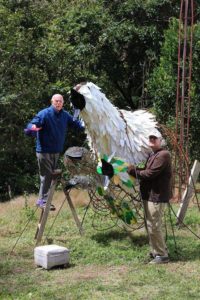
Here is the story of two artists, John Frannea, a frequent visitor to our small community, Monteverde, perched in a cloud forest at the top of the Tilaron mountain range in Costa Rica and I,  Paul Smith,  one-time dairy farmer turned artist, who has been living here with my family for 46 years. The two of us became friends in 2016 and soon discovered some common interests. My latest interests have been covering various surfaces with mosaic, decorative mirrors, murals, and sculptures.  John, a retired accountant, has taken courses in sculpture using recycled material.   The web site, washedashore.org explains the movement to which he is connected.  My interest  in conservation attracted me to John’s dream of creating a mammoth sculpture of a Bellbird, an endangered species,  whose bong, bong call high on the canopy is familiar to locals.  The research of local biologists shows that indeed this bird’s habitat is  endangered. It feeds on specific trees  as it migrates seasonally up and down the mountain. In spite of all their efforts these biologists are worried about deforestation reducing the Bellbird’s habitat.
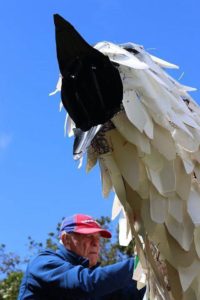
In my enthusiasm  I offered John my backyard and my help.  Fortunately  I soon discovered John was a pro. Our first visit to the hardware store to buy rebar, straight wire,  and chicken wire, and to the large recycling municipal shed  for different colors of plastic–white, brown, green, yellow, and gold– firmly committed us to the project.  The discovery of mountains of clear water bottles with an unclear destiny shocked me. Looking at Monteverde’s mountain of non-biodegradable plastic bottles,  I tried to imagine what an enormous mountain a city would produce.

In spite of all the warning, humanity continues to cut down natural habitat for cows and crops, doused with pesticides and chemicals  to the hazard of our health. We pollute our rivers and oceans with our sewage.  However, our mountain air and  spring water is crystal pure.  What a great energy cost to the planet  we have created by shipping truck loads of water in small plastic bottles up and down the mountain.  The plastic gets reshipped back to the USA for reprocessing,  goes to landfills  or ends up on our beaches. I can only shake my head as most people are oblivious to the dilemma.

Soon we were bending the rebar into the shape of a giant Bellbird family – male, female and two of their young under spread out wings – 10 feet high and 15 feet long.   My job was to confirm that our bent rebar really looked like a bird, and along with John to cut hundreds of feathers out of the plastic bottles,  drill holes in each one, and wire feather by feather on to the chicken wire mesh covering the rebar.  

There was no problem finding white bottles to make the male’s spectacular  white head,  and even the yellow and different colors of greens for the mother and chicks.  Our problem soon became finding the bright siena colors for the male’s wings, tail,  and back.   As usual a solution fell from the sky when I noticed a burned down restaurant with a collapsed bright rusty tin roof  of the colors we needed,  all the feathers to do the job.   We   now continue to make our raids to this sorry site in daylight.  Anyone can challenge us for trespassing,  but so far we just get ignored or passersby give us a polite smile.

The day came to get the bird on a trailer John had purchased to make the sculpture mobile. It was a day of celebration when 15 volunteers gave us a hand and lifted the bird onto its new perch.     With a couple of hundred old tin rusty feathers wired on one by one to the wings, back, and tail,  the trailer will no longer be seen. The eyes will be made from wine bottles cut by a local glass artist, Ángel Castellanos Gómez, and glued in their sockets.

Our bird has yet to be fully hatched, but in the future in some park or school playground it will be a wayside attraction.  The message will be: “Here is the King of the canopy with the loudest bird call on the planet.  Let us not destroy its home.”

Our aim is to finish it by Earth Day  April 29.   That day the bird will join a three-kilometer march from Santa Elena to Monteverde to protest climate warming. With two big hills to climb, can it be pulled by a dozen people ?  We would have to add another wheel to the front.  Plan B: Could our electric golf cart pull this giant bird?   Plan C:  Could we find a team of oxen or horses to do the pulling?  In a future chapter you will learn if it was necessary to resort to a fossil- fuel burning car.

We trust a local conservation group will receive it and use its mobile possibilities to further their educational message:  “Instead of exploiting nature, we must learn to live in harmony as stewards”.

Eventually the chicken  wire will rust and  fall apart and feather by feather will be carried away by the wind – more litter. The rebar will rust into the ground.  In the meantime will we humans get the message so that future generations one day may  enjoy clean air, healthy  oceans, and the bong, bong song of this beautiful bird ringing out over the canopy of our cloud forest, the lungs of the world, reminding us not to destroy our habitat, our only home?  What will be the outcome of the race between our bird’s disintegration and humanity’s awakening? It is our choice.

***************

Pluma por pluma

Escrito por Paul Warren Smith

Nunca olvidaré la vez, después de una reunión de culto cuáquero en Monteverde, en la que Mildred Hoge, un miembro ya mayor del mitin, se levantó para mostrarnos la maravilla de algo nuevo: “Vean cómo no se rompe ni se arruga”. Nos estaba enseñando una bolsa plástica. ¡Fenomenal! Todos estábamos impresionados, pero más tarde supimos que el plástico es un derivado de los combustibles fósiles.

Ahora, algunos de nosotros sabemos que los seres humanos deben buscar una solución para su adicción a los plásticos. Qué hacer con todo el plástico se ha convertido en uno de los problemas más recientes de la humanidad. ¡Cómo han cambiado los tiempos! Durante mis primeros diez años en Monteverde, no recuerdo haber visto un solo carro en el parqueo algún domingo por la mañana. Los huecos de composta se encargaban de todos nuestros desperdicios. Hoy en día, por más que valoremos el turismo, estamos sufriendo por la abundancia de tránsito. Cada año hay un aumento del cinco por ciento en carros que utilizan combustibles fósiles, tanto a nivel nacional como local.

Esta es la historia de dos artistas, John Frannea, un visitante frecuente a nuestra pequeña comunidad de Monteverde, situada en un bosque nuboso en lo más alto de la cordillera de Tilarán, y yo, Paul Smith, un finquero metido a artista que vive aquí con su familia desde hace 46 años. Los dos nos hicimos amigos en el 2016 y pronto descubrimos que teníamos algunos intereses en común. Mi último interés ha sido cubrir diversas superficies con mosaicos, espejos decorativos y esculturas. John, un contador jubilado, ha hecho cursos de escultura con materiales reciclados. Mi interés en la conservación me atrajo a su idea de crear una escultura gigantesca de un pájaro campana, una especie en peligro de extinción cuyo llamado boinj, boinj es conocido por todos los lugareños. Las investigaciones de los biólogos locales han demostrado que el hábitat de esta ave está bajo amenaza. El pájaro campana se alimenta de árboles específicos durante sus migraciones altitudinales. Pese a sus esfuerzos, estos biólogos están preocupados de que la deforestación vaya a disminuir el hábitat del pájaro campana.

En mi entusiasmo ofrecí a John mi patio y mi ayuda. Afortunadamente, pronto descubrí que John era todo un profesional. Nuestra primera visita a la ferretería fue para comprar varillas, alambre y malla, y la primera al centro de acopio de reciclables para recoger plástico de diferentes colores — blanco, marrón, verde, amarillo, dorado… Estas compras sellaron nuestro compromiso con el proyecto. Me causó una gran impresión el descubrimiento de montañas de botellas plásticas con un destino incierto. Viendo las montañas que tiene Monteverde de botellas plásticas no-biodegradables, traté de imaginar lo enormes que serían las montañas que se producen en una ciudad.

Pese a todas las advertencias, la humanidad sigue talando hábitats naturales con el fin de criar ganado y sembrar cultivos bañados de químicos y pesticidas dañinos para la salud. Contaminamos nuestros ríos y mares con aguas negras. Sin embargo, nuestras aguas de manantial y nuestro aire de montaña todavía son puros como el cristal. Qué gran costo de energía hemos creamos para nuestro planeta con todo este transporte de cargamentos de botellas de agua cuesta arriba y cuesta abajo la montaña. El plástico lo devuelven a los EE.UU. para reprocesarlo, o termina en el vertedero, o acaba en nuestras playas. Tan solo puedo sacudir mi cabeza ante el poco interés que muestra la mayoría de la gente por esto.

Pronto estábamos doblando las varillas en forma de una familia de gigantescos pájaros campana — un macho, una hembra y dos polluelos bajo las alas extendidas de sus padres — de tres metros de altura y cuatro metros y medio de largo. Mi trabajo era confirmar que las varillas dobladas se vieran en efecto como un pájaro; luego, entre los dos, recortamos cientos de plumas a partir de las botellas plásticas, taladramos huecos en cada una de las plumas, y pluma por pluma las sujetamos con alambre a la malla con la que habíamos cubierto las varillas.

No fue difícil encontrar botellas blancas para la espectacular cabeza blanca del macho, ni tampoco lo fue para el amarillo y los distintos tonos verdes de la madre y los polluelos. Nuestro problema resultó ser encontrar los colores siena brillante de las alas, cola y lomo del macho. Como siempre, la solución vino caída del cielo: noté un restaurante quemado cuyo techo de zinc oxidado era justo de los colores que necesitábamos, con suficiente material para sacar las plumas con las que terminar el trabajo. Todavía saqueamos aquel sitio lamentable a plena luz del día. Cualquiera nos puede acusar de invadir una propiedad ajena, pero hasta ahora sólo no nos prestan atención, o bien sólo recibimos una sonrisa educada de quienes por ahí pasan.

Llegó el día de montar el ave en un remolque que había comprado John para hacerla una escultura móvil. Fue un día de celebración cuando vinieron 15 voluntarios a ayudarnos a colocar el ave en su nueva percha. Con algunos cientos de plumas de zinc oxidado sujetas con alambre una por una a las alas, cola y lomo, el remolque no se notará. Los ojos estarán hechos de botellas de vino recortadas por un artista local del vidrio, Ángel Castellanos Gómez.

A nuestro pájaro todavía le falta un poco para salir del cascarón, pero en el futuro será una atracción a la orilla del camino de algún parque o patio de recreo. El mensaje será: “He aquí el Rey del dosel. Su llamado es el más fuerte entre las aves. No destruyamos su hogar”.

Nuestro objetivo es terminarlo antes del Día de la Tierra este 29 de abril. Ese día, el pájaro se unirá a una marcha de tres kilómetros desde Santa Elena hasta Monteverde en protesta por el calentamiento global. ¿Podrán diez personas jalarlo cuesta arriba de dos colinas? Tendremos que añadir otra rueda al frente. Plan B: ¿Podría nuestro carro de golf eléctrico jalar este pájaro gigante? Plan C: ¿Podríamos encontrar una yunta de bueyes o de caballos que lo jale? En un capítulo futuro verán si fue necesario recurrir a un automóvil de motor a combustible fósil.

Confiamos en que un grupo conservacionista local lo recibirá y utilizará sus posibilidades móviles para llevar adelante un mensaje educativo: “En lugar de explotar a la naturaleza, debemos aprender a convivir con ella como sus guardianes”.

Tarde o temprano, la malla se herrumbrará y se desmoronorá y pluma por pluma se la llevará el viento — más basura. Las varillas se herrumbrarán hasta terminar en el suelo. Entretanto, ¿habremos entendido el mensaje? ¿Habremos recordado que para que las generaciones futuras puedan disfrutar del aire puro, los océanos sanos, y el llamado boinj, boinj de este hermosa ave resonando por el dosel del bosque nuboso, pulmón del mundo, no debemos destruir nuestro hábitat, nuestro único hogar? ¿Cuál será el resultado de la carrera entre la desintegración de nuestra ave y el despertar de la humanidad? Es nuestra elección.

Faith, Practice, and Our Parking Lot / Fe, práctica y nuestro parqueo

by Katy VanDusen
>> haga clic aquí para leer en español

Sweat soaked my shirt under my armpits.  Could those on the bench next to me feel my trembling?  Was I quaking because I was moved by the Spirit?  Or was it because I was being stubborn? Quaker process requires open minds. Was I staying open?

The next item on the agenda for Meeting for Business was the request from the ad hoc Parking Lot Safety Committee. For a year, as clerk, I had delayed bringing this to Meeting while I urged the committee to help find ways to reduce traffic in the school/meeting parking lot, and reduce greenhouse gas emissions, rather than expanding the lot. That help hadn’t come.

William introduced the proposal.  “…our parking lot is still not safe.  Several times every week there are close calls with children almost being hit by cars.  Without action, there will be a tragedy.”

We paused in silence.  My heart beat faster.

Emily stood to speak.  In 1950, she, her new husband, and 11 other Quaker families left the increasingly militarized U.S. for Costa Rica, which had just abolished its army. They founded Monteverde, which come to be the center of the largest block of privately conserved land in Costa Rica. “Safety is important,” Emily said.  “But what comes to mind is ‘They paved paradise and put up a parking lot.’ We used to have just a grassy area, no parking lot.  We all lived close by and walked. Now I come to Meeting in a car. I understand the need for change.”

I took several deep breaths.

I rose to speak.  “The Carbon Neutrality Committee has calculated that over 90% of our greenhouse gas emissions are from families and staff driving here.  Transport is also the biggest source of emissions in Costa Rica. The number of cars in the country has doubled in the last ten years. Our parking lot has recently become unsafe because there are too many cars. We could make the parking lot safe and reduce our carbon footprint by 75% if we had a school bus.”

Silence.

“The school committee and parents have reviewed a bus plan,” Chris said. “The plan was met with resistance and the school committee decided that it was not a priority for now.  The costs and logistics of operating the bus are complicated.”

Not a priority for now?  How could they say that while the Antarctic Peninsula is breaking apart, the Great Barrier Reef is dying, droughts in Syria, Somalia, and South Sudan are fueling famine and wars, the first hurricane hit Costa Rica four months ago, high-temperature records are set every year, and our cloud forest is drying up? Climate change is a threat to life on earth. And it is probably irreversible! What about the future safety of whole communities, especially poor communities? Quakers are supposed to walk the talk of stewardship. If we won’t act on climate change, who will?

In the silence, could people hear the papers rattling on my shaking knees?

“Could parents organize carpooling?” Molly asked.

Stephanie stood up. “When I raised the question of ride sharing, my neighbors told me that we need to ‘respect our differences.’ I tried to organize a van for students. That didn’t work. I would not be able to use a bus service even if it was provided to my farm, given my work schedule. And what about Meeting members taking responsibility for their emissions? Most meeting attenders don’t just drive, they fly in airplanes!”

The knot in my stomach rose to my throat.  She was speaking to my condition.  I drive an electric golf cart locally, with almost no emissions since Costa Rica’s electricity is 95% renewable, but I fly way too much.  My family, including my 88-year-old mother, is in the US. Could those of us who fly offset our footprint by supporting collective transport for students? But compensating isn’t enough. I need to fly much less.  I have to say no to my husband’s invitation for a trip to Alaska.

Chris stood again. “I suggest that we slow down, invite Spirit into our discussions, and be open to all the possibilities.”

Slow down? I have already been waiting a year. Christiana Figueres says we are already ten years too late. She should know. She led the COP21 Paris talks.

“I would like to see efforts made to improve the flow and safety of the parking lot, to improve the public bus system, and to start an electric bike sharing program.”

Harold, hard-of-hearing, projected loudly. “My friends who have electric bicycles are still addicted to their gas-guzzling cars. They want independence and convenience. Until the economics of electric transport can compete, all else is irrelevant.”

Less silence punctuated the messages.

“The Santa Elena bus is big and goes mostly empty except at peak times,” Cindy said. “I wish smaller buses would run more frequently, like every hour all day.”

People continued to share as I tried to open to the Light Within for guidance.  How can we quickly create the cultural shift needed to wean ourselves from fossil fuels?

Arthur, our current clerk, stood and paused before speaking slowly.  “These issues are urgent, complex, and require more discernment. How can we align our faith with our practice when it comes to the environment, transportation, and our parking lot? Would Friends be interested in having a threshing session to seek clarity on how to proceed?”

We settled again into silence. Should I take this climate mitigation work to the regional level, just as I did when some resisted the idea of the Meeting becoming carbon neutral? The municipality responded enthusiastically then. They even wanted to become carbon negative. Maybe they would be receptive to collective and electric transportation for the whole district. Was Spirit calling me?

****************************

Fe, práctica y nuestro parqueo

Escrito por Katy VanDusen

El sudor empapó mi camisa bajo mis axilas. ¿Podrían los que están en el banco junto a mí sentir mi temblor? ¿Estaba temblando porque fui movido por el Espíritu? ¿O era porque estaba siendo testarudo? El proceso cuáquero requiere mentes abiertas. ¿Estaba abierta?

El siguiente punto del orden del día de la Reunión de Negocios fue la solicitud del Comité de Seguridad del Parqueo. Durante un año, como actuaria, había retrasado traer esto a la reunión mientras que insté al comité ayudar a encontrar maneras de reducir el tráfico en el estacionamiento de la escuela/reunión, y de reducir emisiones del gas del invernadero, en vez de ampliar el parqueo. Esa ayuda no había llegado.

William presentó la propuesta. “… nuestro parqueo todavía no está seguro. Varias veces cada semana carros casi golpean niños. Sin acción, habrá una tragedia “.

Hicimos una pausa en silencio. Mi corazón latía más rápido.

Emily se puso en pie para hablar. En 1950, ella, su nuevo esposo, y otras 11 familias cuáqueras abandonaron los Estados Unidos, que estaban más militarizados cada día, para Costa Rica, que acababa de abolir su ejército. Fundaron Monteverde, que llegó a ser el centro del bloque más grande de tierras privadas conservadas en Costa Rica. “La seguridad es importante”, dijo Emily. “Pero lo que viene a la mente es la canción Gran Taxi Amarillo: ‘Ellos pavimentaron el paraíso y acondicionaron un estacionamiento’. Antes teníamos sólo un área cubierta de hierba, sin parqueo. Todos vivimos cerca y caminamos. Ahora vengo al culto en un auto. Entiendo la necesidad de cambiar. ”

Tomé varias respiraciones profundas.

Me levanté para hablar. “El Comité de Carbono Neutralidad ha calculado que más del 90% de nuestras emisiones de gases de efecto invernadero provienen de familias y del personal que conduce aquí. El transporte es también la mayor fuente de emisiones en Costa Rica. El número de automóviles en el país se ha duplicado en los últimos diez años. Nuestro estacionamiento se ha convertido recientemente en inseguro porque hay demasiados coches. Podríamos hacer el estacionamiento seguro y reducir nuestra huella de carbono en un 75% si tuviéramos un autobús escolar. ”

Silencio.

“El comité de la escuela y los padres han revisado un plan de autobús”, dijo Chris. “El plan fue recibido con resistencia y el comité escolar decidió que no era una prioridad por ahora. Los costos y la logística de operar un autobús son complicados “.

¿No es una prioridad por ahora? ¿Cómo podrían decir eso que mientras que la Península Antártica se está rompiendo, la Gran Barrera de Coral está muriendo, las sequías en Siria, Somalia y Sudán del Sur están alimentando la hambruna y las guerras, el primer huracán golpeó a Costa Rica hace cuatro meses, las temperaturas suban cada año, y nuestro bosque nuboso se está secando? El cambio climático es una amenaza a la vida en la tierra. Y probablemente sea irreversible! ¿Qué pasa con la seguridad futura de comunidades enteras, especialmente comunidades pobres? Se supone que los cuáqueros deben vivir lo que dicen sobre la mayordomía. Si no vamos a actuar sobre el cambio climático, ¿quién lo hará?

En el silencio, ¿podría la gente oír los papeles chirriando en mis rodillas temblorosas?

“¿Podrían los padres organizar el carpooling?” preguntó Molly.

Stephanie se puso de pie. “Cuando planteé la cuestión del viaje compartido, mis vecinos me dijeron que debíamos ‘respetar nuestras diferencias.’ Traté de organizar una buceta para los estudiantes. Eso no funcionó. Yo no sería capaz de utilizar un servicio de autobús, incluso si se proporcionó a mi granja, dado mi horario de trabajo. ¿Y qué pasa con los miembros de la Asociación de los Amigos que asumen la responsabilidad de sus emisiones? La mayoría de los que vienen al culto no sólo conducen, también vuelan en aviones! ”

El nudo en mi estómago se elevó hasta mi garganta. Ella estaba hablando a mi condición. Conduzco un carrito de golf eléctrico a nivel local, casi sin emisiones ya que la electricidad de Costa Rica es 95% renovable, pero vuelo demasiado. Mi familia, incluida mi madre de 88 años, está en los Estados Unidos. ¿Podrían aquellos de nosotros que volamos compensar nuestra huella apoyando el transporte colectivo para los estudiantes? Pero compensar no es suficiente. Necesito volar mucho menos. Tengo que decir que no a la invitación de mi marido para un viaje a Alaska.

Chris volvió a ponerse de pie. “Sugiero que vamos más lentamente, invitamos al Espíritu a nuestras discusiones, y seamos abiertos a todas las posibilidades”.

¿Vamos más despacio? Ya he estado esperando un año. Christiana Figueres dice que ya tenemos diez años de retraso. Ella debería saberlo. Dirigió el acuerdo del COP21 en París.

“Me gustaría ver los esfuerzos realizados para mejorar el flujo y la seguridad del estacionamiento, mejorar el sistema de autobuses públicos y comenzar un programa para compartir bicicletas eléctricas.”

Harold, duro de escuchar, proyectó en voz alta. “Mis amigos que tienen bicicletas eléctricas siguen siendo adictos a sus coches que tragan gasolina. Quieren independencia y conveniencia. Hasta que la economía del transporte eléctrico pueda competir, todo lo demás es irrelevante “.

Menos silencio puntuaba los mensajes.

“El autobús de Santa Elena es grande y está casi vacío, excepto en las horas picas”, dijo Cindy. “Ojalá que los autobuses más pequeños correrían con más frecuencia, como cada hora durante todo el día.”

La gente continuó compartiendo mientras yo trataba de abrirme a la Luz Interior para guiarme.

¿Cómo podemos rápidamente crear el cambio cultural necesario para liberarnos de los combustibles fósiles?

Arturo, nuestro actuario actual, se paró y se detuvo antes de hablar lentamente. “Estos temas son urgentes, complejos y requieren más discernimiento. ¿Cómo podemos alinear nuestra fe con nuestra práctica cuando se trata del medio ambiente, el transporte y nuestro parqueo? ¿Estarían interesados ​​los Amigos en tener una sesión para buscar claridad sobre cómo proceder? ”

Nos acomodamos nuevamente en el silencio. ¿Debo llevar este trabajo de mitigación al cambio climático al nivel regional, al igual que lo hice cuando algunos se resistieron a la idea de que la Asociación de los Amigos fuera carbono neutro? El municipio respondió con entusiasmo en ese tiempo. Incluso querían convertirse en carbon negativo. Tal vez serían receptivos al transporte colectivo y eléctrico para todo el distrito. ¿El Espíritu me llamaba?

Newer posts »